White Noise Machine vs. Fan for Sleep: Which Is Better?
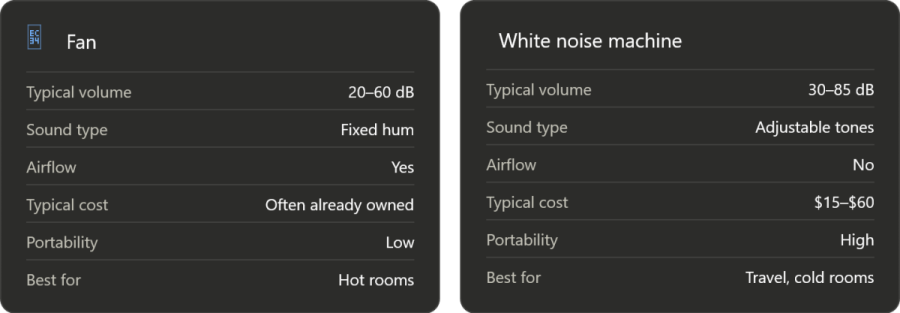
A fan and a white noise machine both cover nighttime noise and help you fall asleep faster. They work through different mechanisms, and each fits a different room, budget, and set of needs. The comparison above lines up sound range, cost, and portability side by side. Below is what the research says about each option, plus guidance on which one fits your situation.
Written with the assistance of Claude AI, reviewed by the Sleep Well Tips team using peer-reviewed sleep research
How a Fan Helps You Sleep
A fan works two ways at once. Moving air across your skin lowers your body temperature, which helps you fall asleep faster in a warm room. The fan also produces a steady hum. This hum masks sudden sounds, such as a door closing or a car outside, through a process called auditory masking. A steady background sound raises the noise floor in your room, so a spike in outside noise stands out less against it.
A 2008 case-control study from Kaiser Permanente found infants who slept with a fan running in the room had a 72 percent lower risk of sudden infant death syndrome, compared with infants who slept without one. The protective effect grew stronger in warmer rooms [1]. The researchers were careful to note the finding does not replace the core safe sleep steps: back sleeping, a firm mattress, and no loose bedding. Talk with your pediatrician before changing your baby’s sleep setup, and treat a fan as one part of a safe sleep routine, not a replacement for it.
A cool, dark, quiet room remains the foundation of healthy sleep at any age. For a deeper breakdown of the habits behind consistent sleep, see why sleep patterns break down and how to reset them.
How a White Noise Machine Helps You Sleep
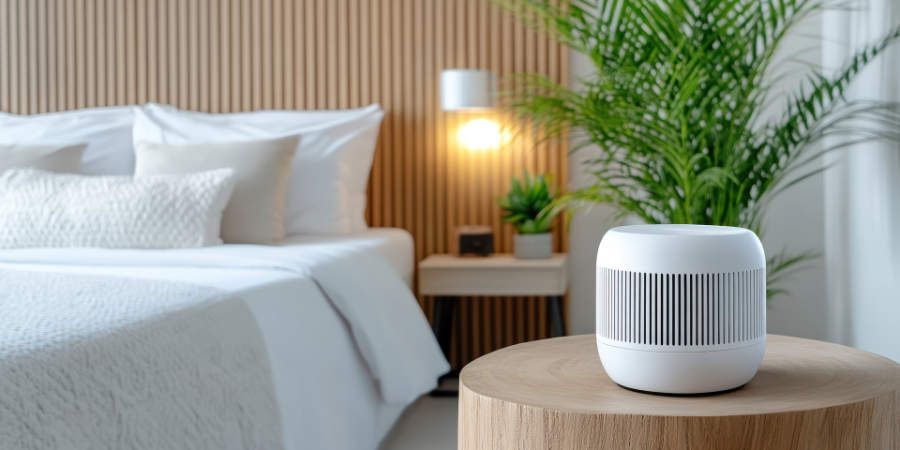
A white noise machine has one job. It produces a controlled, adjustable sound. Unlike a fan, it moves no air and changes no room temperature. Most models offer several sound profiles, including white noise, pink noise, rain, and ocean waves, along with volume control and a timer.
The masking effect works the same way it does with a fan. A 2017 randomized trial published in Frontiers in Neurology sent healthy adults to bed 90 minutes before their normal bedtime, to model temporary insomnia. Subjects exposed to broadband sound fell asleep 38 percent faster than subjects exposed to normal room noise [2]. A separate systematic review of the evidence found mixed results. Some studies show a clear benefit, others show none, and outcomes vary by person and by setting [3]. Treat a white noise machine as an option worth testing, not a guaranteed fix.
Sound Levels and Hearing Safety
This is where the two options differ most, and where safety matters most, especially for a nursery.
Fans stay mechanically limited. Most bedroom fans run somewhere between 20 and 60 decibels, depending on speed and model, roughly the range between a quiet library and a normal conversation.
White noise machines go louder. A 2014 study in Pediatrics measured 14 infant sleep machines at maximum volume. All 14 exceeded 50 A-weighted decibels at 30 centimeters, the limit recommended for hospital nurseries. Three of the 14 exceeded 85 decibels, a level which, if sustained for more than eight hours, exceeds adult occupational noise limits [4]. A 2021 study of consumer sound machines and phone apps found similar results at high volume settings [5].
The World Health Organization recommends indoor bedroom noise stay below 30 decibels for good sleep quality, and outdoor night noise stay under an annual average of 40 decibels to prevent health effects [6].
Practical guidance: if you use a white noise machine, especially in a nursery, keep the volume moderate, place the device at least two meters from where the head rests, and pick the lowest setting which still works for you. A fan on low or medium speed rarely reaches these levels in the first place, which makes it a simpler default choice for a baby’s room when extra airflow fits the season.
Cost and Practicality
Most households already own a fan, so trying one for sleep costs nothing extra. A dedicated white noise machine runs 15 to 60 dollars for most consumer models, with some higher-end options costing more. A phone app offers a free alternative, though speaker quality varies.
A fan draws more electricity than a white noise machine. The difference amounts to a few cents a week at typical utility rates, so cost is not the deciding factor for either option.
Portability splits the two devices apart. A white noise machine travels well. It fits in a bag, needs no assembly, and works the same in a hotel room or a dorm as it does at home. A box fan or pedestal fan takes up more space and needs regular cleaning of the blades and grille to keep dust from building up.
If noise from outside your bedroom is the real problem, not background hum inside it, sound masking only goes so far. For a longer-term fix, look at door seals, window treatments, and other soundproofing options and what they cost. If noisy neighbors are the main disruption, pairing a fan or white noise machine with basic soundproofing works better than masking sound alone.
Which One Fits Your Situation
- Hot bedroom or no separate cooling: choose a fan. It manages airflow and noise masking together.
- Nursery or infant room: put hearing safety first. Keep any sound source at a low volume, placed away from the crib, or rely on a fan at low speed for gentle masking with ventilation. Confirm the choice with your pediatrician.
- Apartment or shared walls: either device works for masking. Pair it with basic soundproofing for the loudest disruptions.
- Frequent travel or dorm living: pick a compact white noise machine, or a phone app, since it fits a bag better than a fan.
- Dry eyes, allergies, or sinus trouble: skip direct airflow. Use a white noise machine, or point a fan away from your face, to avoid drying out your eyes and nose overnight.
- Tight budget: start with a fan you already own before buying a dedicated device.
Neither device wins outright. A fan adds cooling and gentle sound masking at no added cost. A white noise machine gives you more sound control and travels better, and it needs closer attention to volume and placement. Match the device to your room, your budget, and, where a baby sleeps in the room, to established sound-safety limits over sound variety.
Sources
- Coleman-Phox K, Odouli R, Li DK. Use of a fan during sleep and the risk of sudden infant death syndrome. Archives of Pediatrics and Adolescent Medicine, 2008. https://pubmed.ncbi.nlm.nih.gov/18838649/
- Messineo L, Taranto-Montemurro L, Sands SA, et al. Broadband sound administration improves sleep onset latency in healthy subjects in a model of transient insomnia. Frontiers in Neurology, 2017. https://www.frontiersin.org/journals/neurology/articles/10.3389/fneur.2017.00718/full
- Noise as a sleep aid: a systematic review. Sleep Medicine Reviews, ScienceDirect. https://www.sciencedirect.com/science/article/abs/pii/S1087079220301283
- Hugh SC, Wolter NE, Propst EJ, Gordon KA, Cushing SL, Papsin BC. Infant sleep machines and hazardous sound pressure levels. Pediatrics, 2014. https://publications.aap.org/pediatrics/article/133/4/677/32749/Infant-Sleep-Machines-and-Hazardous-Sound-Pressure
- Hazardous sound outputs of white noise devices intended for infants. International Journal of Pediatric Otorhinolaryngology, ScienceDirect. https://www.sciencedirect.com/science/article/abs/pii/S0165587621001506
- World Health Organization Regional Office for Europe. Noise. https://www.who.int/europe/news-room/fact-sheets/item/noise