How to Create the Ideal Sleep Environment for Better Rest
Your bedroom sends five signals to your brain before you close your eyes: temperature, humidity, light, sound, and air quality. Miss one, and the other four struggle to compensate. Most bedroom guides cover temperature and light. Few mention air quality, even though new ventilation research links it directly to sleep efficiency. This guide covers all five signals, plus your mattress and a habit tying the whole room together.

Written with the assistance of Claude AI, reviewed by the Sleep Well Tips team using peer-reviewed sleep research
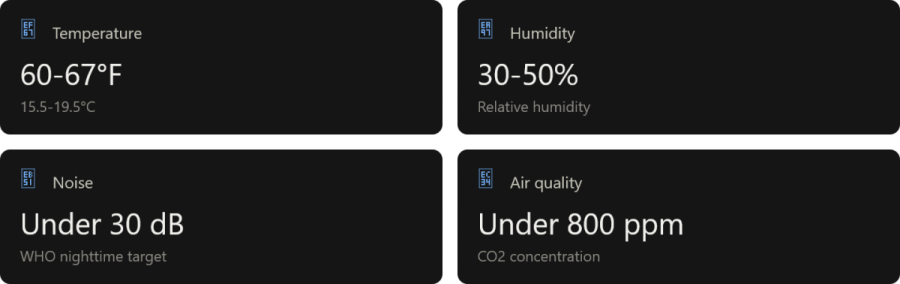
Here is the quick reference for the four numeric targets covered below.
Set Your Bedroom Temperature Between 60 and 67 Degrees Fahrenheit
Set your thermostat between 60 and 67 degrees Fahrenheit, or 15.5 to 19.5 degrees Celsius. This range lines up with your body’s natural temperature drop before sleep. Core temperature falls in the evening and rises again toward morning. A cool room supports the drop instead of fighting it.
Age changes the equation. Research from the Marcus Institute for Aging Research at Harvard Medical School, published in Science of the Total Environment, found adults over 65 slept most efficiently between 68 and 77 degrees Fahrenheit, with efficiency dropping 5 to 10 percent as the room warmed from 77 to 86 degrees. Older bodies regulate internal temperature less precisely than younger ones, so a slightly warmer room often works better for them. Couples spanning different ages benefit from breathable, adjustable bedding rather than forcing one temperature on both people.
Above 75 degrees, sleep quality drops fast for most adults. Deep sleep shortens, REM sleep fragments, and you wake up more often during the night. See our guide on nighttime heating and bedroom temperature for ways to manage heat sources safely.
Keep Bedroom Humidity Between 30 and 50 Percent
Relative humidity in your bedroom belongs between 30 and 50 percent, according to the Environmental Protection Agency and sleep researchers. Air below 30 percent dries your throat and nasal passages, leading to snoring, coughing, and early waking. Air above 50 percent traps heat against your skin and feeds dust mites and mold, both common allergy triggers disrupting sleep.
A hygrometer costs little and removes the guesswork. Below 30 percent, run a humidifier. Above 50 percent, a dehumidifier or exhaust fan pulls out the excess moisture. Humidity and temperature interact directly: damp air feels warmer than dry air at the same reading, so fixing humidity often solves a temperature complaint too.
Block Light to Protect Your Melatonin
Light sets your internal clock more strongly than any other bedroom factor. A Harvard Health review found eight lux, dimmer than most table lamps, suppresses melatonin production. A Brigham and Women’s Hospital study measured how room light before bed delays melatonin onset and shortens the nightly window your body spends producing it.
Blue-wavelength light from phones, tablets, and LED bulbs suppresses melatonin more than warmer light. Cover glowing LED indicators on electronics. Install blackout curtains or a fitted liner if streetlights or early dawn light reach your room. Mayo Clinic recommends dimming household lights and turning off screens 30 to 60 minutes before bedtime to let melatonin rise on schedule.
Cut Noise Below 30 Decibels
The World Health Organization sets 30 decibels as the target for continuous bedroom noise at night. Sound above 40 decibels disrupts sleep architecture in measurable ways: more time in light sleep, fewer deep sleep cycles, and higher cortisol after waking, even without a full awakening.
A white noise machine, a fan, and earplugs all lower perceived noise without construction work. Weatherstripping around doors and windows blocks outside sound at low cost. Our guide to earplug alternatives for sleeping covers comfortable substitutes, including sound-muffling sleep masks, for anyone who finds earplugs uncomfortable.
Ventilate Your Bedroom to Control CO2
Bedroom air quality gets far less attention than temperature or light, yet a 2023 study in the journal Building and Environment found carbon dioxide levels of 1,000 parts per million reduced sleep efficiency by 1.3 percent and added five minutes of nightly wakefulness, compared with a well-ventilated 750 ppm baseline. At 1,300 ppm, wakefulness rose by nearly eight minutes and deep sleep duration fell.
A closed bedroom door and window let CO2 climb through the night as you exhale. A review of 17 studies recommended keeping bedroom CO2 below 800 ppm, a target most homes miss without deliberate ventilation.
Cracking a window a few inches lowers CO2 and cools the room in one step, though it also lets in outside noise. If traffic or neighbors make an open window impractical, leave the bedroom door open with a fan running in the hallway, or install a trickle vent. A basic CO2 monitor, priced close to a hygrometer, tells you whether your bedroom needs more airflow.
Choose a Supportive Mattress and Pillow
Mattress firmness changes sleep quality and pain levels more than most people expect. A study in the Journal of Chiropractic Medicine tracked adults who replaced worn mattresses and pillows with new medium-firm bedding and found meaningful improvements in both back pain and sleep quality within a month. A separate controlled trial published through the National Library of Medicine found adults with mild insomnia symptoms slept better and reported less pain after eight weeks on a pressure-relieving medium-firm mattress.
Most mattresses last 7 to 10 years, though foam models wear out closer to 5 and natural latex holds up past 12. Replace yours if you wake up stiff, notice visible sagging, or sleep better in a hotel bed than your own. Pair a supportive mattress with a pillow keeping your neck level with your spine. Side sleepers typically need a thicker pillow than back or stomach sleepers.
Reserve Your Bed for Sleep Only
Your brain builds associations fast. Work from bed, scroll your phone from bed, or watch television from bed, and your brain starts treating the bed as a place for alertness instead of sleep. Sleep researchers call this stimulus control, a core part of cognitive behavioral therapy for insomnia.
Move your laptop, phone charger, and TV out of the bedroom, or at minimum off the bed itself. If sleep does not come within 20 minutes, get up, sit somewhere else, and do something quiet until you feel drowsy, then return to bed. Repeat as needed rather than lying awake and frustrated. For more ways to rebuild a consistent sleep routine, see our guide on why you might only be sleeping every other night.
Try This One-Night Sleep Environment Audit
Fixing every variable at once makes it hard to know what worked. Audit your bedroom in the order below, ranked by how strongly current research ties each factor to sleep quality.
- Temperature and humidity first. These interact directly and take five minutes to adjust with a thermostat and a hygrometer.
- Light second. Cover LED indicators and hang blackout curtains before addressing noise or air.
- Noise third. Test a fan or white noise machine for three nights before investing in soundproofing.
- Air quality fourth. Crack a window or add a trickle vent, then notice whether you wake up less groggy.
- Mattress and pillow last. These cost the most to change, so rule out the free fixes first.
Track how you feel each morning for a week, on a simple 1 to 5 scale. Small, consistent gains across several nights carry more weight than one great night after a single change.
When Bedroom Changes Are Not Enough
A well-designed bedroom solves environmental sleep problems, not medical ones. Loud snoring, gasping during sleep, insomnia lasting more than a few weeks, or daytime sleepiness persisting despite a good sleep environment are signs to talk with a doctor or a sleep specialist. Conditions such as sleep apnea, restless legs syndrome, and chronic insomnia need diagnosis and treatment beyond bedroom adjustments.
Your bedroom works as one connected system. A humidifier fixes dry air but does nothing for noise. Blackout curtains block light but leave CO2 to build up behind a closed door. Work through the five factors together, and the room starts doing part of the work your body used to handle alone.
For a visual walkthrough of these fixes, watch the Mayo Clinic Human Optimization Project episode on repairing a sleep environment.
References
- Sleep Foundation: Best Temperature for Sleep
- Baniassadi et al., Nighttime Ambient Temperature and Sleep in Community-Dwelling Older Adults, PubMed
- Sleep Foundation: Humidity and Sleep
- World Health Organization: Noise Fact Sheet
- Harvard Health Publishing: Blue Light Has a Dark Side
- Cajochen et al., Exposure to Room Light Before Bedtime Suppresses Melatonin Onset, PubMed
- Ventilation Causing an Average CO2 Concentration of 1,000 ppm Negatively Affects Sleep, ScienceDirect
- Jacobson et al., Changes in Back Pain, Sleep Quality, and Perceived Stress After Introduction of New Bedding Systems, ScienceDirect
- Mayo Clinic: Sleep Tips, 6 Steps to Better Sleep