How Long Should You Nap? The Best Nap Length Without Hurting Night Sleep
Most adults do best with a nap of 10 to 20 minutes. That length gives your brain a break without dragging you into deep sleep, so you wake up alert instead of groggy. Anything between 30 and 60 minutes tends to backfire, and naps close to bedtime can chip away at your night sleep even when they feel harmless in the moment.
Roughly one in three American adults naps on a given day, according to the National Sleep Foundation. Napping itself is not the problem. Length and timing decide whether a nap helps you or costs you later.

Written with the assistance of Claude AI, reviewed by the Sleep Well Tips team using peer-reviewed sleep research
The Short Answer
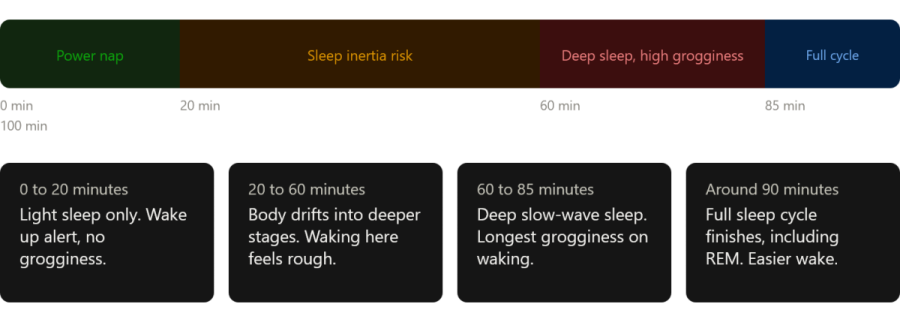
- 10 to 20 minutes: Best for most people. Quick alertness boost, no grogginess, low risk to night sleep.
- 20 to 60 minutes: Higher chance of waking mid-deep-sleep, which causes sleep inertia, the groggy, confused feeling after waking.
- 90 minutes: Completes a full sleep cycle, including REM. Useful if you’re catching up on lost sleep, but takes a real time commitment.
- Best window: Early afternoon, ideally before 2 or 3 p.m.
What Happens in Your Brain During a Nap
Sleep moves through stages in a repeating cycle that lasts around 90 minutes. You start in light sleep, drop into deeper slow-wave sleep, then cycle into REM sleep before the pattern restarts. Where you are in that cycle when your alarm goes off determines how you feel afterward.
Wake up during light sleep and you feel clear-headed almost right away. Wake up during slow-wave sleep and your brain needs time to catch up, a state researchers call sleep inertia. The Centers for Disease Control and Prevention’s fatigue research division notes that sleep deepens steadily for about the first hour, so a nap that runs 30 to 60 minutes has strong odds of ending mid-deep-sleep, right where grogginess hits hardest.
The Three Nap Zones, Explained
Power nap, 15 to 20 minutes. Cleveland Clinic sleep medicine specialist Nancy Foldvary-Schaefer, DO, points to this range as the sweet spot. You stay in light sleep, so waking up feels immediate and clear. Mayo Clinic gives a similar range, 20 to 30 minutes, and adds a second rule: keep this your daily habit rather than the exception.
Recovery nap, 20 to 60 minutes. Useful after a rough night or with a new baby in the house, but Cleveland Clinic warns against making it routine. The longer you sleep in this window, the higher your odds of surfacing from deep sleep feeling worse than before you closed your eyes.
Full cycle nap, around 90 minutes. This length carries you through an entire sleep cycle, so you exit near the light-sleep stage again instead of mid-cycle. It supports memory and creative thinking through REM sleep, but it demands 90 uninterrupted minutes, which few schedules allow on a regular day.
The NASA Nap: What the Famous Study Actually Found
You have probably seen the claim: a 26-minute nap improves performance by 34 percent and alertness by 54 percent. The number comes from a real 1995 NASA study led by researcher Mark Rosekind, run on long-haul airline pilots during trans-Pacific flights. Pilots given a rest break fell asleep in about 5.6 minutes on average and slept for roughly 26 minutes. Compared with pilots who did not nap, the rest group showed measurable gains in reaction time and physiological alertness.
The catch worth knowing: this study looked at sleep-deprived pilots on overnight flights, not office workers on an ordinary afternoon. The figures are real, but treat them as evidence that brief naps help under fatigue, not as a guarantee that exactly 26 minutes outperforms 15 or 20 for everyone. NASA’s own broader guidance still points to shorter naps, in the 10 to 20 minute range, for most situations.
When to Nap
Timing matters as much as length. Mayo Clinic recommends napping in the early afternoon and avoiding naps after 3 p.m., since sleep taken too close to bedtime competes with your night sleep for the same sleep pressure that helps you fall asleep quickly. Sleep pressure builds steadily from the moment you wake up, and a late nap releases some of that pressure right when you need it for bedtime.
A simple rule from sleep researchers: keep naps at least eight hours before your planned bedtime. If you go to bed at 11 p.m., finish napping by 3 p.m. If you are especially sensitive to sleep disruption, an earlier cutoff gives you more of a buffer.
The early afternoon slot also lines up with a natural dip in alertness most people feel a few hours after lunch, driven by your circadian rhythm rather than the meal itself. Napping during that window works with your body’s rhythm instead of against it.
Does Napping Hurt Your Night Sleep?
Not automatically. Sleep Foundation research points to a straightforward pattern: short naps taken earlier in the day rarely interfere with night sleep, while long or late-afternoon naps make it harder to fall asleep at your usual bedtime.
People with insomnia or fragmented night sleep tend to be more sensitive to this effect. If you already struggle to fall or stay asleep at night, a 20-minute nap before early afternoon is a safer bet than an hour-long nap at 4 p.m.
One more point worth being direct about: naps cannot fully replace lost night sleep. A short nap can sharpen focus for a few hours, but it does not erase the sleep debt built up from short nights. Chronic reliance on naps to get through the day, especially if you struggle to stay awake despite regular naps, is worth mentioning to a doctor. It can signal an underlying issue such as sleep apnea or narcolepsy rather than a simple lack of napping.
Quick Self-Check: Is Your Nap Helping or Hurting?
Three questions to sort out whether your napping habit works for you.
- How long did you sleep? Under 30 minutes, low risk. Between 30 and 60 minutes, worth adjusting. Consistently over an hour, worth tracking closely.
- What time was it? Before 2 or 3 p.m., generally safe. After that, your night sleep is the one paying the price.
- How do you feel right after? Alert within a few minutes means your timing works. Confused or sluggish for 20 minutes or more points to a nap that ran too long or hit the wrong sleep stage.
How to Nap Well
- Set an alarm. Guessing your way out of a nap is how 20 minutes turns into 55.
- Nap somewhere dark, cool, and quiet. The same conditions that help night sleep help a nap work faster.
- Try a coffee nap. Drink coffee right before a 20-minute nap. Caffeine takes about 20 to 30 minutes to take effect, so it kicks in right as you wake, stacking two alertness boosts instead of one.
- Keep it consistent. A regular nap time trains your body to fall asleep fast and wake up clean, instead of fighting your circadian rhythm each time.
- Skip the nap entirely if you already sleep well at night and don’t feel a dip in energy. Napping is a tool for a specific problem, not a requirement.
Protect Your Sleep Schedule Beyond the Nap
A single well-timed nap fixes an afternoon slump. A messed-up sleep schedule needs a different approach. If your nap habit has crept later in the day or gotten longer without you noticing, our guide on fixing a disrupted sleep schedule walks through resetting your rhythm step by step.
If naps are covering for chronic short nights rather than an occasional bad one, the underlying issue is sleep debt. Our breakdown of why sleep sometimes skips a night entirely covers the stress and schedule patterns behind that kind of sleep loss.
And if you are weighing a nap against simply pushing through a tired afternoon, our look at staying awake versus sleeping for an hour breaks down what the research says about short naps compared with powering through on caffeine alone.
Nap length is not one-size-fits-all, but the pattern holds for most healthy adults. Keep it short, keep it early, and let a 90-minute nap earn its place only when you have the time and the sleep debt to justify it.
Sources
- Cleveland Clinic. What’s the Ideal Length for a Nap? https://health.clevelandclinic.org/are-long-naps-bad-for-you-and-if-so-why
- Mayo Clinic. Napping: Do’s and Don’ts for Healthy Adults. https://www.mayoclinic.org/healthy-lifestyle/adult-health/in-depth/napping/art-20048319
- Sleep Foundation. Napping: Benefits and Tips. https://www.sleepfoundation.org/napping
- Sleep Foundation. Does Napping Impact Your Sleep at Night? https://www.sleepfoundation.org/how-sleep-works/does-napping-impact-sleep-at-night
- Sleep Foundation. NASA Nap: How to Power Nap Like an Astronaut. https://www.sleepfoundation.org/sleep-hygiene/nasa-nap
- CDC, NIOSH. Napping, an Important Fatigue Countermeasure. https://www.cdc.gov/niosh/work-hour-training-for-nurses/longhours/mod7/05.html