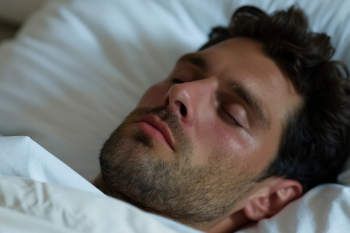
Why Can’t I Fall Back Asleep After Waking Up at Night?
You open your eyes at 3 a.m. Your body feels tired, but your brain refuses to switch off. Ten minutes turn into thirty. Thirty turn into an hour. This pattern has a name: sleep-maintenance insomnia, and it affects millions of adults every night.

Written with the assistance of Claude AI, reviewed by the Sleep Well Tips team using peer-reviewed sleep research
National health data confirm the scale. In the United States, 17.8% of adults report trouble staying asleep most days or every day, according to the Centers for Disease Control and Prevention. The rate rises with age: 13.8% among adults 18 to 44, 21.8% among adults 45 to 64, and 20.3% among adults 65 and older. Women report the problem more often than men, at 20.7% versus 14.7%.
This guide covers four things: what happens in your brain during a wake-up, the six most common triggers, an original diagnostic framework from our team, and the exact steps researchers recommend for getting back to sleep fast.
What Happens In Your Brain During A Nighttime Wake-Up
Sleep moves in cycles of about ninety minutes. Each cycle carries you through light sleep, deep sleep, and REM sleep. Between cycles, your brain surfaces toward wakefulness for a few seconds or minutes. Good sleepers pass through this window without noticing it happened.
Insomnia changes this pattern. Instead of drifting past the surfacing point, your brain locks into an alert state. Researchers call this hyperarousal. Your heart rate rises. Your mind starts working through problems, plans, and worries. This state once helped early humans respond to threats. Now it keeps you staring at the ceiling.
Harvard Health Publishing describes this specific pattern as sleep-maintenance insomnia, the inability to remain asleep through the night. It differs from sleep-onset insomnia, which affects how long it takes you to fall asleep in the first place. The two often overlap, but the triggers and fixes differ.
For more on building consistent nightly habits, see our guide on what sleep hygiene means.
Six Common Reasons You Wake Up And Stay Awake
- Racing thoughts and stress. Your brain reviews the day or previews tomorrow the moment it has quiet space to work in.
- Light exposure. A phone screen, a hallway light, or early sunlight tells your brain daytime has begun.
- Noise. A snoring partner, traffic, or a barking dog pulls you out of sleep and keeps your nervous system on alert.
- Temperature. A too-warm bedroom blocks the natural drop in core body temperature your body needs to stay asleep.
- A full bladder. Nighttime urination, known as nocturia, becomes more common with age and disrupts sleep continuity.
- An undiagnosed sleep disorder. Sleep apnea, restless legs syndrome, and other conditions fragment sleep throughout the night.
For a full room-by-room breakdown of environment fixes, see how to create the ideal sleep environment for better rest.
The Sleep Well Tips Wake-Up Map
Most sleep articles list causes and list fixes as two separate blocks. We built a shorter path. Our team reviewed the causes above against three checkpoints you assess for yourself in the middle of the night. Match your situation to the row below and go straight to the fix.
- Checkpoint one: If your mind feels busy the moment you wake up, your driver is cognitive. Skip the clock, skip the phone, and use a breathing technique before you do anything else.
- Checkpoint two: If your body feels uncomfortable, hot, or like you need the bathroom, your driver is physical. Solve the physical trigger first, then return to bed once you feel neutral again.
- Checkpoint three: If this happens most nights, three or more times a week, for over a month, your driver likely sits outside your control. Treat this as a signal to talk with a doctor rather than a habit to fix alone.
This mapping matters, because treating a cognitive wake-up with a physical fix rarely works, and treating a physical wake-up with a mental technique leaves the actual trigger unresolved. Match the driver, not the symptom.
Why Checking The Clock Makes It Worse
Reaching for your phone or glancing at a clock feels like a natural response to a wake-up. Research says otherwise. A 2023 study from Indiana University tracked nearly 5,000 sleep clinic patients. Clock-watching, formally called time monitoring behavior, worsened insomnia symptoms and raised the odds of turning to sleep medication.
A controlled study on clock-monitoring in insomnia patients, published in the Journal of Behavior Therapy and Experimental Psychiatry, split participants into two groups: one watched a clock while trying to fall back asleep, the other watched a neutral digit display. The clock-watching group reported more pre-sleep worry and took longer to fall back asleep than the display group. The clock itself became a trigger.
The fix is simple. Turn your clock away from view. Leave your phone in another room or face down and silenced. If you wake up and don’t know the time, you remove one entire source of frustration.
Six Evidence-Based Steps To Fall Back Asleep
- Leave your bed after 20 minutes. Sleep researcher Richard Bootzin built this rule, known as stimulus control therapy, in 1972. If sleep hasn’t returned within 15 to 20 minutes, get up and sit somewhere dim and quiet. Return only when you feel sleepy. This keeps your brain from linking your bed with wakefulness.
- Skip the light. Keep any light you use dim and low, never overhead. Bright light delays the release of melatonin, the hormone your body uses to regulate sleep timing. Read our full guide on how blue light affects sleep for room-by-room settings.
- Try slow breathing. Slow, deep breaths activate your parasympathetic nervous system, the part of your body responsible for rest. A common pattern: inhale for four counts, hold for seven, exhale for eight.
- Stop counting the hours. Do not calculate how much sleep you lost or how many hours remain before your alarm. This math feeds the exact frustration research links to worse outcomes.
- Keep your wake time fixed. Get up at the same time each morning, regardless of how the night went. A stable wake time strengthens your circadian rhythm and makes future nights more predictable.
- Save naps for later. Resist the urge to nap the next day to make up for lost sleep. Naps reduce your drive to sleep the following night and restart the cycle of nighttime waking.
When A Wake-Up Signals Something More Serious
Occasional nighttime waking rarely means a serious problem. But some patterns deserve medical attention. Talk with your doctor if you notice:
- Waking up gasping for air or with loud, irregular snoring
- Trouble staying asleep three or more nights a week for a month or longer
- Daytime sleepiness strong enough to affect your driving, work, or mood
- Leg discomfort or an urge to move your legs at night
- Waking up with chest pain, palpitations, or shortness of breath
These signs point to sleep apnea, restless legs syndrome, or a cardiac issue. A sleep specialist or your doctor needs to evaluate these directly. See our guide on the common signs of a sleep disorder and when to see a doctor for a full checklist. Self-treating a medical sleep disorder with lifestyle changes alone delays proper care.
For a doctor’s overview of insomnia causes and treatment, watch this explainer video.
What To Try Tonight
Pick one step from this guide and use it the next time you wake up. Turn your clock away from view. Keep your phone in another room. Get up after 20 minutes if sleep hasn’t returned. Small, consistent changes rebuild your brain’s connection between your bed and sleep, one night at a time.
Sources
Centers for Disease Control and Prevention, National Center for Health Statistics, Sleep Difficulties in Adults: United States, 2020: https://www.cdc.gov/nchs/products/databriefs/db436.htm
Harvard Health Publishing, Too Early to Get Up, Too Late to Get Back to Sleep: https://www.health.harvard.edu/staying-healthy/too-early-to-get-up-too-late-to-get-back-to-sleep
Dawson S, et al. Use of Sleep Aids in Insomnia: The Role of Time Monitoring Behavior, Primary Care Companion for CNS Disorders: https://www.psychiatrist.com/pcc/use-of-sleep-aids-in-insomnia-the-role-of-time-monitoring-behavior/
Tang NKY, et al. Clock Monitoring in the Maintenance of Insomnia, Journal of Behavior Therapy and Experimental Psychiatry: https://www.med.upenn.edu/cbti/assets/user-content/documents/Tang2007_SleepingwiththeEnemy-ClockMonitoringintheMaintenanceofInsomnia.pdf
Cognitive Behavioral Therapy for Insomnia (CBT-I): A Primer: https://pmc.ncbi.nlm.nih.gov/articles/PMC10002474/
Mayo Clinic, Insomnia: How Do I Stay Asleep?: https://www.mayoclinic.org/diseases-conditions/insomnia/expert-answers/insomnia/faq-20057824