Why Do I Wake Up at the Same Time Every Night?
You open your eyes. The room is dark. The clock reads 3:14 AM, close to the time it read last night, and the night before. This pattern is not random. Your body runs on an internal clock, and this clock controls hormone release, sleep depth, and arousal signals on a fixed schedule. When several of these signals line up at the same point in the night, you wake at the same hour, over and over.
Written with the assistance of Claude AI, reviewed by the Sleep Well Tips team using peer-reviewed sleep research
What Is Happening in Your Body
Sleep is not one steady state. It moves through cycles, and each cycle ends with a brief rise toward wakefulness. Layered onto this pattern is your circadian rhythm, a 24-hour internal clock which raises and lowers hormone levels on a set schedule regardless of when you fall asleep. The National Institute of General Medical Sciences explains this clock sits in a brain region called the suprachiasmatic nucleus, and it coordinates almost every biological process tied to day and night, including body temperature, hormone release, and alertness.
Two systems, one built into your sleep cycle and one built into your 24-hour clock, tend to reach a similar point on a similar schedule night after night, if your bedtime stays consistent. The result: a wake-up window which repeats.
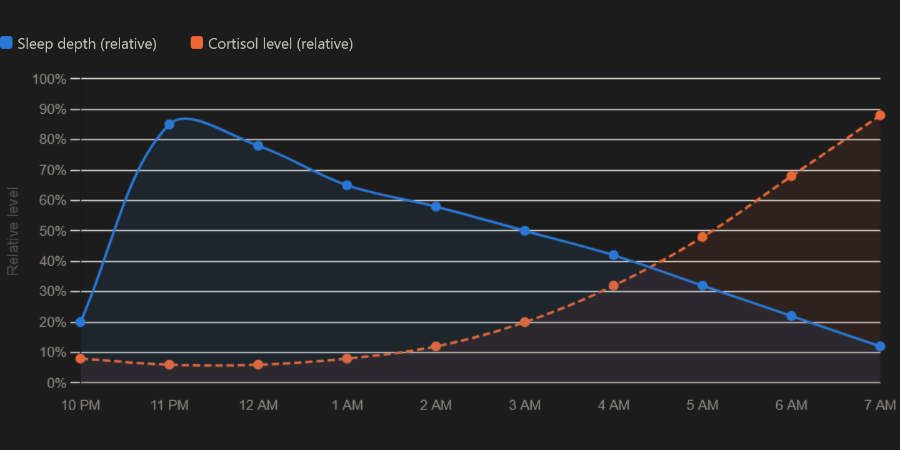
The chart above lays out a simplified, illustrative model of two overnight patterns: sleep depth, which peaks early and tapers off, and cortisol, which stays low overnight and climbs toward morning. Individual nights vary, and the exact hours shift from person to person, but the crossing point, where sleep depth has dropped and cortisol has started climbing, sits close to where most reported early-morning wake-ups land. The sections below unpack each line on this chart.
Your Sleep Runs in 90-Minute Loops
Across a full night, you move through four sleep stages: three stages of non-REM sleep and one stage of REM sleep, according to the National Institute of Neurological Disorders and Stroke. Each loop through these stages takes around 90 to 110 minutes. Deep sleep dominates the first loops of the night. REM sleep and lighter stages take over the later loops, closer to morning.
Light sleep sits closer to the surface of wakefulness. A noise, a change in room temperature, or a shift in body position wakes you more easily during light sleep than during deep sleep. Since deep sleep concentrates early and light sleep concentrates late, the back half of the night carries a higher chance of a brief awakening landing at, or close to, a fixed clock time.
Cortisol Rises Hours Before Your Alarm
Cortisol is a hormone tied to alertness. Under normal conditions, levels stay low through the evening and the first half of the night, then rise through early morning to prepare your body for waking. Board-certified sleep medicine physician Pranshu Adavadkar, MD, notes this rise, called the cortisol awakening response, typically peaks between 6 and 8 AM, according to the Sleep Foundation. Stress, an irregular schedule, or a shift in circadian timing push this rise earlier, sometimes into the 2 to 4 AM range.
Once cortisol crosses a certain threshold, it works against sleep directly. This is one reason falling back asleep after a 3 AM wake-up feels harder than falling back asleep after a wake-up at midnight. Your body is already moving toward its wake signal.
Blood Sugar and Adrenaline Add a Second Trigger
A drop in blood glucose during the night sets off a rescue response. The liver releases stored sugar, and the body releases counter-regulatory hormones, including adrenaline and cortisol, to correct the drop. Research tracking hypoglycemia during sleep with polysomnography found the rise in epinephrine came before the moment of waking, by several minutes, in participants who woke during a glucose drop.
Researchers document this mechanism most closely in people with diabetes, since the connection between glucose and waking carries direct treatment relevance for this group. A heavy, carbohydrate-dense meal late in the evening produces a similar dip in blood sugar several hours later in people without diabetes too, though the size of the effect varies by person. If your wake-up time lands three to four hours after dinner, this timing is worth a look.
Alcohol Disrupts Sleep in the Second Half of the Night
Alcohol sedates early in the night and disturbs sleep later. Research on alcohol and sleep architecture documents a consistent pattern: alcohol suppresses REM sleep during the first half of the night, then REM sleep rebounds during the second half as the body metabolizes the alcohol. This rebound period brings lighter, more fragmented sleep, and a higher chance of waking.
If your usual wake-up time lands four to five hours after your last drink, alcohol is a strong candidate. Our guide on drinking before bed and its effect on sleep covers timing in more depth.
Your Brain Learns the Pattern, Then Repeats It
A body-based trigger explains the first few nights. Habit explains why the pattern continues. Sleep researchers call this conditioned arousal: after repeated nights of waking, checking the clock, and feeling frustrated, the brain pairs the bed, and the act of waking, with alertness rather than rest. The American Academy of Sleep Medicine’s clinical guideline on insomnia treatment describes this cycle directly: the bed turns into a cue for waking arousal, reinforced night after night.
This explains a detail many people notice: the wake-up continues on nights with no stress, no alcohol, and no late meal. The original trigger fades, and a learned response takes its place. Our piece on relaxing your mind and body before sleep covers techniques directed at breaking this loop.
Other Causes Worth Ruling Out
A recurring wake-up time sometimes points to a condition beyond circadian timing or habit. Rule these out before assuming the cause is behavioral:
- Sleep apnea. Repeated pauses in breathing pull you out of deep sleep, often at a point tied to sleep position or airway anatomy.
- Acid reflux. Lying flat lets stomach acid move upward a few hours after a meal, producing a burning sensation which interrupts sleep.
- Restless legs syndrome. An urge to move the legs worsens at night and during stillness, disrupting sleep at a similar point most nights.
- Hormonal shifts. Perimenopause, menopause, and thyroid conditions change body temperature regulation and hormone timing, producing night sweats and wake-ups at a similar hour.
- Medication timing. Diuretics, beta-blockers, and several other medications interfere with sleep continuity or push urination needs into a specific window overnight.
A pattern repeating for more than a few weeks, especially alongside snoring, gasping, leg discomfort, or daytime exhaustion, is worth raising with a doctor rather than working through alone. Our guide on stress-driven sleep disruption covers more on this pattern.
Steps to Reset Your Wake-Up Time
Small, consistent changes shift this pattern over two to four weeks in most cases. Start here:
- Set a fixed wake-up time, seven days a week, including weekends. A moving wake-up time keeps your circadian rhythm unstable and reinforces irregular signals.
- Get outside within 30 minutes of waking. Morning light is the strongest cue your circadian clock responds to, and it helps anchor cortisol timing to the correct window.
- Cut alcohol and heavy meals within three hours of bedtime. Both interfere with the second half of your sleep cycle.
- Skip the clock check. Looking at the time during a night wake-up adds a stress response on top of the original trigger, and it reinforces the learned wakefulness pattern.
- Get out of bed after 20 minutes awake. Move to another room, keep the lights low, and return to bed once you feel drowsy. Staying in bed while alert strengthens the bed-equals-wakefulness association.
- Track your wake-up time for two weeks. A consistent pattern points toward a circadian or hormonal cause. An irregular pattern points more toward environment, stress, or diet.
When to See a Doctor
Occasional nighttime waking is normal and needs no treatment. Raise the issue with a doctor if the wake-up happens most nights for a month or longer, if it comes with gasping, snoring, or leg discomfort, or if daytime exhaustion affects your work or safety. A doctor rules out sleep apnea, restless legs syndrome, thyroid conditions, and other treatable causes mimicking a habitual wake-up pattern.
For a deeper look at how circadian timing works, this interview with sleep researcher Professor Jason Ellis walks through the mechanics of the body clock.
Sources
- Sleep Foundation. Why Do I Keep Waking Up at Night? Medically reviewed by Pranshu Adavadkar, MD. sleepfoundation.org
- National Institute of General Medical Sciences. Circadian Rhythms. nigms.nih.gov
- National Institute of Neurological Disorders and Stroke. Brain Basics: Understanding Sleep. ninds.nih.gov
- National Library of Medicine, PubMed Central. Defective Awakening Response to Nocturnal Hypoglycemia in Patients with Type 1 Diabetes Mellitus. ncbi.nlm.nih.gov
- National Library of Medicine, PubMed Central. Alcohol Use Disorder and Sleep Disturbances: A Feed-Forward Allostatic Framework. pmc.ncbi.nlm.nih.gov
- American Academy of Sleep Medicine. Clinical Guideline for the Evaluation and Management of Chronic Insomnia in Adults. aasm.org